
UNITED STATES
SECURITIES AND EXCHANGE COMMISSION
WASHINGTON, D.C. 20549
FORM 8-K
CURRENT REPORT
Pursuant to Section 13 or 15(d) of the Securities Exchange Act of 1934
Date of Report (Date of earliest event reported): July 1, 2025
(Exact Name of Registrant as Specified in Its Charter)
|
|
|
|
|
(State or Other Jurisdiction of Incorporation)
|
(Commission File No.)
|
(IRS Employer Identification No.)
|
|
|
|
|
|
(Address of Principal Executive Offices)
|
(Zip Code)
|
(517 )
543-6400
(Registrant’s Telephone Number, Including Area Code)
Not Applicable
(Former Name or Former Address, if Changed Since Last Report)
Check the appropriate box below if the Form 8-K filing is intended to simultaneously satisfy the filing obligation of the registrant under any of the following
provisions:
|
Written communications pursuant to Rule 425 under the Securities Act (17 CFR 230.425)
|
|
Soliciting material pursuant to Rule 14a-12 under the Exchange Act (17 CFR 240.14a-12)
|
|
Pre-commencement communications pursuant to Rule 14d-2(b) under the Exchange Act (17 CFR 240.14d-2(b))
|
|
Pre-commencement communications pursuant to Rule 13e-4(c) under the Exchange Act (17 CFR 240.13e-4(c))
|
Securities registered pursuant to Section 12(b) of the Act:
|
Title of each class
|
Trading
Symbol(s)
|
Name of each exchange on which registered
|
||
|
|
|
|
Indicate by check mark whether the registrant is an emerging growth company as defined in Rule 405 of the Securities Act of 1933 (§ 230.405 of this chapter) or Rule 12b-2
of the Securities Exchange Act of 1934 (§ 240.12b-2 of this chapter). Emerging growth company ☐
If an emerging growth company, indicate by check mark if the registrant has elected not to use the extended transition period for complying with any new or revised
financial accounting standards provided pursuant to Section 13(a) of the Exchange Act.
INTRODUCTORY NOTE
As previously disclosed in our Current Report on Form 8-K filed with the United States Securities and Exchange Commission (the “SEC”)
on December 16, 2024, The Shyft Group, Inc., a Michigan corporation (the “Company”), entered into that certain Agreement and Plan of Merger, dated as of December 16, 2024 (as amended, restated or
otherwise modified from time to time, the “Merger Agreement”), by and among the Company, Aebi Schmidt Holding AG, a Switzerland Aktiengesellschaft (“Aebi Schmidt”),
ASH US Group, LLC, a Delaware limited liability company and direct, wholly owned subsidiary of Aebi Schmidt (“Holdco”), and Badger Merger Sub, Inc., a Michigan corporation and direct, wholly owned
subsidiary of Holdco (“Merger Sub”).
On July 1, 2025, Merger Sub merged with and into the Company (the “Merger”) pursuant to the terms of the Merger Agreement
and in accordance with the Business Corporation Act of the State of Michigan MCL 450.1101 et seq., as amended (the “MCL”), with the Company surviving the Merger as a direct, wholly owned subsidiary of
Holdco and as an indirect, wholly owned subsidiary of Aebi Schmidt.
At the effective time of the Merger (the “Effective Time”):
| 1. |
each share of common stock, no par value, of the Company (“Company Common Stock”) issued and outstanding as of immediately prior to the Effective
Time (other than any shares of Company Common Stock that were held as of immediately prior to the Effective Time by Holdco, Aebi Schmidt, Merger Sub or any of their respective subsidiaries) automatically converted into the right to receive
1.040166432 (the “Exchange Ratio”) fully paid and nonassessable shares of common stock, par value $1.00 per share, of Aebi Schmidt (“Aebi Schmidt Common Stock”)
(such shares, in aggregate, the “Merger Consideration”);
|
| 2. |
each outstanding restricted stock unit with respect to shares of Company Common Stock (other than the Company Director RSUs (as defined below)) (each, a “Company Non-Director RSU”)
was assumed by Aebi Schmidt and converted into a number of restricted stock units with respect to shares of Aebi Schmidt Common Stock (each, an “Aebi Schmidt RSU”), determined by multiplying (a)
the total number of shares of Company Common Stock underlying such Company Non-Director RSU by (b) the Exchange Ratio;
|
| 3. |
each outstanding performance-vested restricted stock unit with respect to shares of Company Common Stock (each, a “Company PSU”) was assumed by Aebi Schmidt and
converted into a number of Aebi Schmidt RSUs determined by multiplying, (a) for the period prior to the date of the Merger Agreement, (i) the total number of shares of Company Common Stock subject to such Company PSU as of immediately prior
to the Effective Time, assuming performance goals are achieved based on the higher of target or actual performance as of immediately prior to the date of the Merger Agreement, by (ii) the Exchange Ratio, and (b) for the period commencing on
the date of the Merger Agreement and ending on the Effective Time, (i) the total number of shares of Company Common Stock subject to such Company PSU immediately prior to the Effective Time, assuming performance goals are achieved based on
target performance as of immediately prior to the Effective Time, by (ii) the Exchange Ratio.
|
| 4. |
each outstanding restricted stock unit with respect to shares of Company Common Stock that was held by a non-employee director of Company (each, a “Company Director RSU”)
vested in full and was cancelled and converted into the right to receive a number of shares of Aebi Schmidt Common Stock determined by multiplying (a) the total number of shares of Company Common Stock underlying such Company Director RSU,
by (b) the Exchange Ratio.
|
The Merger Agreement has been incorporated by reference as an exhibit to this report to provide information regarding its terms and conditions. It is not intended to
provide any other factual information about the Company, Aebi Schmidt, Holdco, Merger Sub, or any of their respective subsidiaries or affiliates. The representations, warranties and covenants contained in the Merger Agreement (i) were made by the
parties thereto only for purposes of the Merger Agreement and as of specific dates; (ii) were made solely for the benefit of the parties to the Merger Agreement; (iii) may be subject to limitations agreed upon by the contracting parties, including
being qualified by confidential disclosures exchanged between the parties in connection with the execution of the Merger Agreement; (iv) may have been made for the purposes of allocating contractual risk between the parties to the Merger Agreement
instead of establishing these matters as facts; and (v) may be subject to standards of materiality applicable to the contracting parties that differ from those applicable to other persons. Moreover, information concerning the subject matter of
representations and warranties may change after the date of the Merger Agreement.
| ITEM 1.02 |
TERMINATION OF A MATERIAL DEFINITIVE AGREEMENT.
|
On July 1, 2025, substantially concurrently with the consummation of the Merger, the Company repaid in full all outstanding indebtedness, discharged and all other
obligations (except those obligations that expressly survive termination) and terminated all credit commitments, security agreements and liens outstanding under that certain Amended and Restated Credit Agreement, dated as of November 30, 2021 (as
amended, restated, amended and restated, supplemented or otherwise modified from time to time, the “Credit Agreement”), by and among the Company, the lenders from time to time party thereto, Wells Fargo
Bank, National Association, as administrative agent, and certain other parties thereto. Upon such termination, all rights, obligations (except those obligations that expressly survive the termination of the Credit Agreement), liabilities and
security interests under the Credit Agreement were fully released and discharged.
The foregoing description of the Credit Agreement does not purport to be complete, and is subject to, and qualified in its entirety by reference to, the full text of
the Credit Agreement, which is attached as Exhibit 10.1 to the Company’s Current Report on Form 8–K filed with the SEC on December 1, 2021, together with amendments thereto attached as Exhibits 10.2 and 10.1 to the Company’s Quarterly Report on
Form 10-Q and Company’s Current Report on Form 8-K filed with the SEC on June 27, 2023 and March 29, 2024, respectively.
| ITEM 2.01 |
COMPLETION OF ACQUISITION OR DISPOSITION OF ASSETS.
|
As described in the Introductory Note of this Current Report on Form 8-K, on July 1, 2025, the Merger was completed. Upon the consummation of the Merger, the Company
became a direct, wholly owned subsidiary of Holdco and an indirect, wholly owned subsidiary of Aebi Schmidt. The disclosure under the Introductory Note to this Current Report on Form 8-K is incorporated herein by reference.
| ITEM 3.01 |
NOTICE OF DELISTING OR FAILURE TO SATISFY A CONTINUED LISTING RULE OR STANDARD; TRANSFER OF LISTING.
|
The disclosures under the Introductory Note of this Current Report on Form 8-K are incorporated herein by reference.
On June 30, 2025, in connection with the consummation of the Merger, the Company requested that The Nasdaq Global Select Market (“Nasdaq”)
halt trading of Company Common Stock effective following closing of the after-market trading session at or about 8:00 P.M., Eastern Time, on June 30, 2025.
On July 1, 2025, the Company requested that Nasdaq (a) suspend trading of the shares of Company Common Stock at the close of market trading on July 1, 2025, and (b)
file on behalf of the Company a Notification of Removal from Listing and/or Registration on Form 25 with the SEC on July 1, 2025 in accordance with Rule 12d2-2(a)(3) promulgated under the Securities Exchange Act of 1934, as amended (the “Exchange Act”), to effect the delisting of Company Common Stock from Nasdaq and to deregister the shares of Company Common Stock under Section 12(b) of the Exchange Act. In addition, the Company intends to
file with the SEC a Certification and Notice of Termination of Registration on Form 15 requesting that the Company’s reporting obligations under Sections 13 and 15(d) of the Exchange Act be suspended.
|
ITEM 3.03
|
MATERIAL MODIFICATION TO RIGHTS OF SECURITY HOLDERS.
|
The disclosures under the Introductory Note and Items 2.01, 3.01 and 5.03 of this Current Report on Form 8-K are incorporated herein by reference.
At the Effective Time, each holder of shares of Company Common Stock issued and outstanding immediately prior to the Effective Time ceased to have any rights with
respect to such shares and as a shareholder of the Company, except the right to receive the Merger Consideration and the right, if any, to receive cash in lieu of any fractional shares and any dividends or other distributions with respect to Aebi
Schmidt Common Stock without any interest, in each case, pursuant to the terms and conditions set forth in the Merger Agreement.
|
ITEM 5.01
|
CHANGES IN CONTROL OF REGISTRANT.
|
The disclosures under the Introductory Note and Items 2.01, 3.01, 3.03, 5.02 and 5.03 of this Current Report on Form 8-K are incorporated herein by reference.
As a result of the Merger, a change in control of the Company occurred, and the Company became a direct, wholly owned subsidiary of Holdco and an indirect, wholly
owned subsidiary of Aebi Schmidt.
| ITEM 5.02 |
DEPARTURE OF DIRECTORS OR CERTAIN OFFICERS; ELECTION OF DIRECTORS; APPOINTMENT OF CERTAIN OFFICERS; COMPENSATORY ARRANGEMENTS OF CERTAIN OFFICERS.
|
The disclosures under the Introductory Note and Item 2.01 of this Current Report on Form 8-K are incorporated herein by reference.
Pursuant to the Merger Agreement, as of the Effective Time, each of James A. Sharman, John Dunn, Michael Dinkins, Carl Esposito, Angela Freeman, Pamela Kermisch, Paul
Mascarenas, Terri Pizzuto and Mark Rourke, comprising all of the members of the Company’s board of directors, ceased serving as a member of the Company’s board of directors and each committee thereof. Pursuant to the Merger Agreement, as of the Effective Time, each of Barend Fruithof and Thomas Schenkirsch, comprising all of the members of the board of directors of Merger
Sub as of immediately prior to the Effective Time, became a member of, and collectively comprise the sole members of, the Company’s board of directors.
Each of Jacob Farmer, the Company’s President, Fleet Vehicles & Services, and Scott Ocholik, the Company’s
interim Chief Financial Officer, who were officers of the Company as of immediately prior to the Effective Time, continued to be an officer of, and collectively comprise the sole officers of, the Company.
Promptly following the Effective Time, Mr. Dunn, who prior to the Effective Time served as the Company’s Chief Executive Officer, resigned his employment for “Good
Reason” (as described in The Shyft Group, Inc. Executive Severance Plan (the “Executive Severance Plan”)), entitling him to receive severance benefits described in the Executive Severance Plan.
As further disclosed in a Current Report on Form 8-K filed with the SEC on May 20, 2025, on May 19, 2025, the Company and Joshua A. Sherbin, who prior to the Effective
Time served as the Company’s Chief Legal, Administrative and Compliance Officer and Corporate Secretary, entered into a Transition and Separation Agreement pursuant to which, among other things, Mr. Sherbin served in his executive roles with the
Company until the Effective Time, and then resigned from his employment with the Company for “Good Reason” as described in the Executive Severance Plan.
| ITEM 5.03 |
AMENDMENTS TO ARTICLES OF INCORPORATION OR BYLAWS.
|
The disclosures under the Introductory Note and Item 2.01 of this Current Report on Form 8-K are incorporated herein by reference.
Pursuant to the Merger Agreement, effective as of the Effective Time, the restated certificate of incorporation of the Company and the second amended and restated
bylaws of the Company were each amended and restated in their entirety, as set forth in Exhibits 3.1 and 3.2, respectively, to this Current Report on Form
8-K, which are incorporated herein by reference.
|
ITEM 9.01
|
FINANCIAL STATEMENTS AND EXHIBITS.
|
(d) Exhibits.
|
Exhibit
No.
|
Description
|
|
104
|
Cover Page Interactive Data File - the cover page XBRL tags are embedded within the Inline XBRL document
|
SIGNATURE
Pursuant to the requirements of the Securities Exchange Act of 1934, as amended, the Registrant has duly caused this Current Report on Form 8-K to be signed on its behalf
by the undersigned hereunto duly authorized.
|
THE SHYFT GROUP, INC.
|
||
|
Date: July 1, 2025
|
By:
|
/s/ Jay Goldbaum |
| Name: |
Jay Goldbaum | |
| Title: |
Deputy General Counsel |
Exhibit 3.1
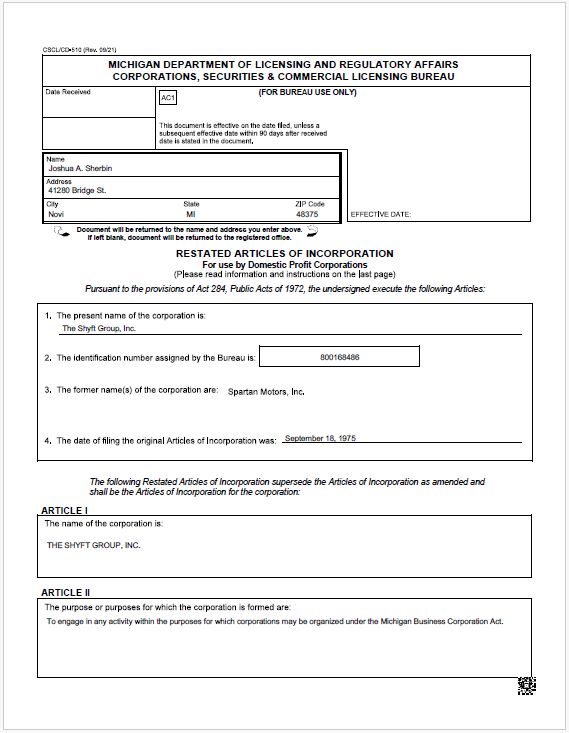
CSCUCD-510 (Rev. 09/21) MICHIGAN DEPARTMENT OF LICENSING AND REGULATORY AFFAIRS CORPORATIONS, SECURITIES & COMMERCIAL LICENSING BUREAU
Date Received AC1 (FOR BUREAU USE ONLY) This document is effective on the date filed, unless a subsequent effective date within 90 days after received date is stated in the document. Name Joshua A. Sherbin Address 41280 Bridge St. City State
ZIP Code Novi MI 48375 EFFECTIVE DATE: Document will be returned to the name and address you enter above. If left blank, document will be returned to the registered office. RESTATED ARTICLES OF INCORPORATION For use by Domestic Profit
Corporations (Please read information and instructions on the last page) Pursuant to the provisions of Act 284, Public Acts of 1972, the undersigned execute the following Articles: 1. The present name of the corporation is: The Shyft Group,
Inc. 2. The identification number assigned by the Bureau is: 800168486 3. The former name(s) of the corporation are: Spartan Motors, Inc. The date of filing the original Articles of Incorporation was: September 18, 1975 The following Restated
Articles of Incorporation supersede the Articles of Incorporation as amended and shall be the Articles of Incorporation for the corporation: ARTICLE I The name of the corporation is: THE SHYFT GROUP, INC. ARTICLE II The purpose or purposes for
which the corporation is formed are: To engage in any activity within the purposes for which corporations may be organized under the Michigan Business Corporation Act.
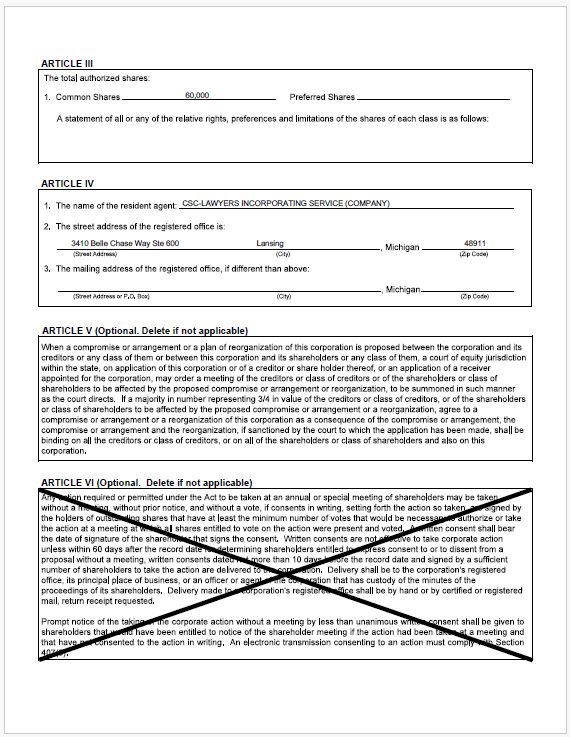
ARTICLE III The total authorized shares: 1. Common Shares 60,000
Preferred Shares A statement of all or any of the relative rights, preferences and limitations of the shares of each class is as follows: ARTICLE IV 1. The name of the resident agent: CSC-LAWYERS INCORPORATING SERVICE (COMPANY) 2. The
street address of the registered office is: 3410 Belle Chase Way Ste 600 Lansing, Michigan 48911 (Street Address) (City) (Zip Code) 3. The mailing address of the registered office, if different than above: ,Michigan (Street Address or
P,O, Box) (City) (Zip Code) ARTICLE V (Optional. Delete if not applicable) When a compromise or arrangement or a plan of reorganization of this corporation is proposed between the corporation and its creditors or any class of them or
between this corporation and its shareholders or any class of them, a court of equity jurisdiction within the state, on application of this corporation or of a creditor or share holder thereof, or an application of a receiver appointed
for the corporation, may order a meeting of the creditors or class of creditors or of the shareholders or class of shareholders to be affected by the proposed compromise or arrangement or reorganization, to be summoned in such manner as
the court directs. If a majority in number representing 3/4 in value of the creditors or class of creditors, or of the shareholders or class of shareholders to be affected by the proposed compromise or arrangement or a reorganization,
agree to a compromise or arrangement or a reorganization of this corporation as a consequence of the compromise or arrangement, the compromise or arrangement and the reorganization, if sanctioned by the court to which the application has
been made, shall be binding on all the creditors or class of creditors, or on all of the shareholders or class of shareholders and also on this corporation. ARTICLE VI (Optional. Delete if not applicable) Any action required or permitted
under the Act to be taken at an annual or special meeting of shareholders may be taken without a meeting, without prior notice, and without a vote, if consents in writing, setting forth the action so taken, are signed by the holders of
outstanding shares that have at least the minimum number of votes that would be necessary to authorize or take the action at a meeting at which all shares entitled to vote on the action were present and voted. A written consent shall bear
the date of signature of the shareholder that signs the consent. Written consents are not effective to take corporate action unless within 60 days after the record date for determining shareholders entitled to express consent to or to
dissent from a proposal without a meeting, written consents dated not more than 10 days before the record date and signed by a sufficient number of shareholders to take the action are delivered to the corporation. Delivery shall be to the
corporation's registered office, its principal place of business, or an officer or agent of the corporation that has custody of the minutes of the proceedings of its shareholders. Delivery made to a corporation's registered office shall
be by hand or by certified or registered mail, return receipt requested. Prompt notice of the taking of the corporate action without a meeting by less than unanimous written consent shall be given to shareholders that would have been
entitled to notice of the shareholder meeting if the action had been taken at a meeting and that have not consented to the action in writing. An electronic transmission consenting to an action must comply with Section 407(3).
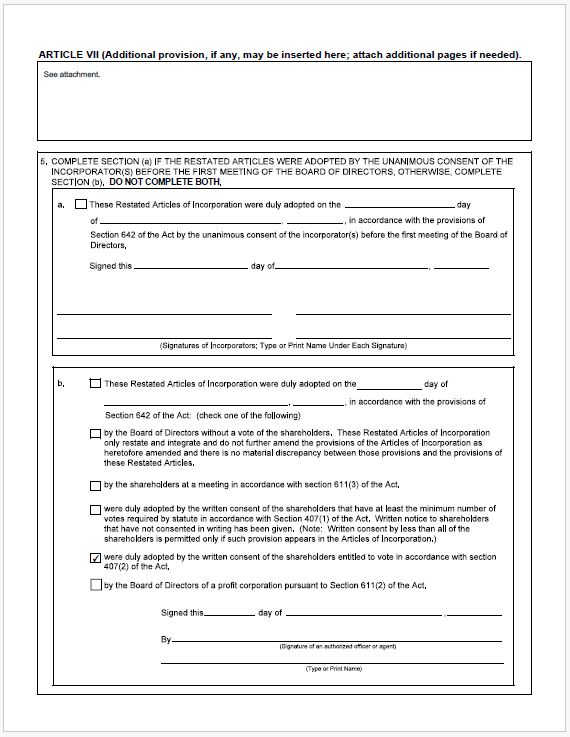
ARTICLE VII (Additional provision, if any, may be inserted here; attach
additional pages if needed). See attachment. 5. COMPLETE SECTION (a) IF THE RESTATED ARTICLES WERE ADOPTED BY THE UNANIMOUS CONSENT OF THE INCORPORATOR(S) BEFORE THE FIRST MEETING OF THE BOARD OF DIRECTORS, OTHERWISE, COMPLETE SECTION
(b). DO NOT COMPLETE BOTH a. These Restated Articles of Incorporation were duly adopted on the day of, in accordance with the provisions of Section 642 of the Act by the unanimous consent of the incorporator(s) before the first meeting of
the Board of Directors. Signed this day of (Signatures of lncorporators; Type or Print Name Under Each Signature) b. These Restated Articles of Incorporation were duly adopted on the day of , in accordance with the provisions of Section
642 of the Act: (check one of the following) by the Board of Directors without a vote of the shareholders. These Restated Articles of Incorporation only restate and integrate and do not further amend the provisions of the Articles of
Incorporation as heretofore amended and there is no material discrepancy between those provisions and the provisions of these Restated Articles. by the shareholders at a meeting in accordance with section 611(3) of the Act. were duly
adopted by the written consent of the shareholders that have at least the minimum number of votes required by statute in accordance with Section 407(1) of the Act. Written notice to shareholders that have not consented in writing has been
given. (Note: Written consent by less than all of the shareholders is permitted only if such provision appears in the Articles of Incorporation.) were duly adopted by the written consent of the shareholders entitled to vote in accordance
with section 407(2) of the Act. by the Board of Directors of a profit corporation pursuant to Section 611(2) of the Act. Signed this day of By (Signature of an authorized officer or agent) (Type or Print Name)
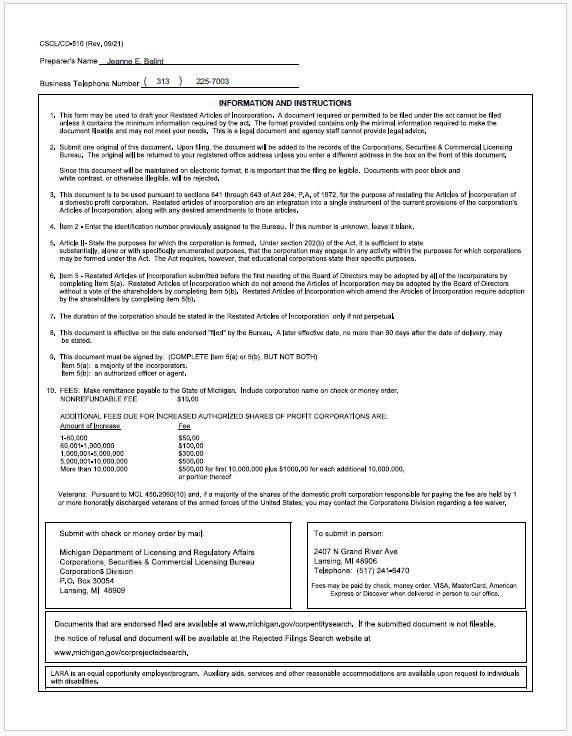
CSCL/CD-510 (Rev. 09/21) Preparer's Name Jeanne E. Balint Business
Telephone Number (313) 225-7003 INFORMATION AND INSTRUCTIONS 1. This form may be used to draft your Restated Articles of Incorporation. A document required or permitted to be filed under the act cannot be filed unless it contains the
minimum information required by the act. The format provided contains only the minimal information required to make the document fileable and may not meet your needs. This is a legal document and agency staff cannot provide legal advice.
2. Submit one original of this document. Upon filing, the document will be added to the records of the Corporations, Securities & Commercial Licensing Bureau. The original will be returned to your registered office address unless you
enter a different address in the box on the front of this document. Since this document will be maintained on electronic format, it is important that the filing be legible. Documents with poor black and white contrast, or otherwise
illegible, will be rejected. 3. This document is to be used pursuant to sections 641 through 643 of Act 284, P.A. of 1972, for the purpose of restating the Articles of Incorporation of a domestic profit corporation. Restated articles of
incorporation are an integration into a single instrument of the current provisions of the corporation's Articles of Incorporation, along with any desired amendments to those articles. 4. Item 2 - Enter the identification number
previously assigned to the Bureau. If this number is unknown, leave it blank. 5. Article II- State the purposes for which the corporation is formed. Under section 202(b) of the Act, it is sufficient to state substantially, alone or with
specifically enumerated purposes, that the corporation may engage in any activity within the purposes for which corporations may be formed under the Act. The Act requires, however, that educational corporations state their specific
purposes. 6. Item 5 - Restated Articles of Incorporation submitted before the first meeting of the Board of Directors may be adopted by all of the incorporators by completing Item 5(a). Restated Articles of Incorporation which do not
amend the Articles of Incorporation may be adopted by the Board of Directors without a vote of the shareholders by completing Item 5(b). Restated Articles of Incorporation which amend the Articles of Incorporation require adoption by the
shareholders by completing item 5(b). 7. The duration of the corporation should be stated in the Restated Articles of Incorporation only if not perpetual. 8. This document is effective on the date endorsed "filed" by the Bureau. A later
effective date, no more than 90 days after the date of delivery, may be stated. 9. This document must be signed by: (COMPLETE Item 5(a) or 5(b), BUT NOT BOTH) Item 5(a): a majority of the incorporators. Item 5(b): an authorized officer or
agent. 10. FEES: Make remittance payable to the State of Michigan. Include corporation name on check or money order. NONREFUNDABLE FEE $10.00 ADDITIONAL FEES DUE FOR INCREASED AUTHORIZED SHARES OF PROFIT CORPORATIONS ARE: Amount of
Increase 1-60,000 60,001-1,000,000 1,000,001-5,000,000 5,000,001-10,000,000 More than 10,000,000 Fee $50.00 $100.00 $300.00 $500.00 $500.00 for first 10,000,000 plus $1000.00 for each additional 10,000,000, or portion thereof Veterans:
Pursuant to MCL 450.2060(10) and, if a majority of the shares of the domestic profit corporation responsible for paying the fee are held by 1 or more honorably discharged veterans of the armed forces of the United States, you may contact
the Corporations Division regarding a fee waiver. Submit with check or money order by mail: Michigan Department of Licensing and Regulatory Affairs Corporations, Securities & Commercial Licensing Bureau Corporations Division P.O. Box
30054 Lansing, Ml 48909 To submit in person: 2407 N Grand River Ave Lansing, Ml 48906 Telephone: (517) 241-6470 Fees may be paid by check, money order, VISA, MasterCard, American Express or Discover when delivered in person to our office.
Documents that are endorsed filed are available at www.michigan.gov/corpentitysearch. If the submitted document is not fileable, the notice of refusal and document will be available at the Rejected Filings Search website at
www.michigan.gov/corprejectedsearch. LARA is an equal opportunity employer/program. Auxiliary aids, services and other reasonable accommodations are available upon request to individuals with disabilities.
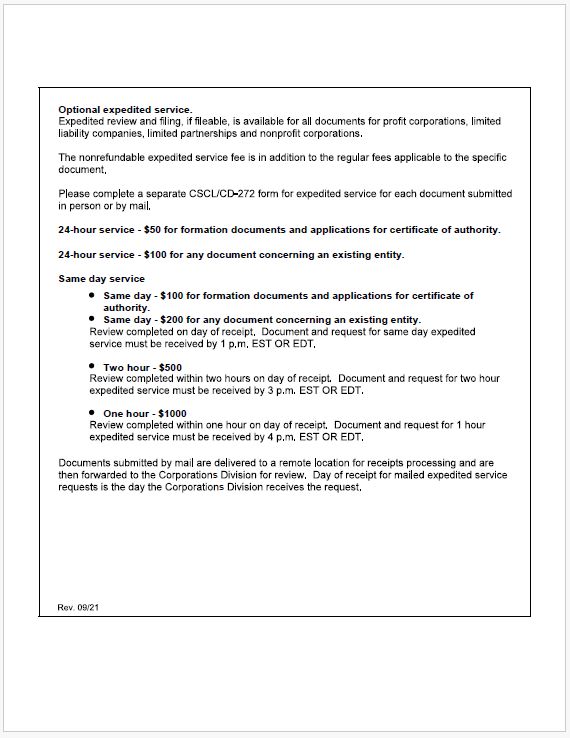
Optional expedited service. Expedited review and filing, if fileable, is available for all documents for profit corporations, limited liability
companies, limited partnerships and nonprofit corporations. The nonrefundable expedited service fee is in addition to the regular fees applicable to the specific document. Please complete a separate CSCL/CD-272 form for expedited service
for each document submitted in person or by mail. 24- hour service - $50 for formation documents and applications for certificate of authority. 24-hour service - $100 for any document concerning an existing entity. Same day service • Same
day - $100 for formation documents and applications for certificate of authority. • Same day - $200 for any document concerning an existing entity. Review completed on day of receipt. Document and request for same day expedited service must
be received by 1 p.m. EST OR EDT. • Two hour - $500 Review completed within two hours on day of receipt. Document and request for two hour expedited service must be received by 3 p.m. EST OR EDT. • One hour - $1000 Review completed within
one hour on day of receipt. Document and request for 1 hour expedited service must be received by 4 p.m. EST OR EDT. Documents submitted by mail are delivered to a remote location for receipts processing and are then forwarded to the
Corporations Division for review. Day of receipt for mailed expedited service requests is the day the Corporations Division receives the request. Rev. 09/21
Attachment to Restated Articles of Incorporation
The Shyft Group, Inc.
Identification Number: 800168486
ARTICLE VII: The Corporation shall indemnify directors and executive officers of the Corporation as of right to the fullest extent now or hereafter
permitted by law in connection with any actual or threatened civil, criminal, administrative, or investigative action, suit, or proceeding (whether brought by or in the name of the corporation, a subsidiary, or otherwise) arising out of their
service to the corporation, a subsidiary, or to another organization at the request of the corporation or a subsidiary. The Corporation may indemnify persons who are not directors or executive officers of the Corporation to the extent authorized by
bylaw, resolution of the Board of Directors, or contractual agreement authorized by the Board of Directors. The Corporation may purchase and maintain insurance to protect itself and any such director, officer, or other person against any liability
asserted against him or her and incurred by him or her in respect of such service whether or not the Corporation would have the power to indemnify him or her against such liability by law or under the provisions of this Article VII. The provisions
of this Article VII shall apply to actions, suits, or proceedings, whether arising from acts or omissions occurring before or after the adoption of this Article VII, and to directors, officers, and other persons who have ceased to render such
service, and shall inure to the benefit of the heirs, executors, and administrators of the directors, officers, and other persons referred to in this Article VII.
ARTICLE VIII. A director of the Corporation shall not be liable to the Corporation or its shareholders for money damages for any action taken or any failure to take any
action as a director, except liability for any of the following: (a) the amount of a financial benefit received by a director to which he or she is not entitled; (b) an intentional infliction of harm on the Corporation or its shareholders; (c) a
violation of section 551 of the Michigan Business Corporation Act; or ( d) an intentional criminal act. In the event the Michigan Business Corporation Act is amended after the approval by the shareholders of this Article to authorize corporate
action further eliminating or limiting the personal liability of directors, then the liability of a director of the Corporation shall be eliminated or limited to the fullest extent permitted by the Michigan Business Corporation Act, as so amended.
Any repeal, modification or adoption of any provision in these Articles of Incorporation inconsistent with this Article shall not adversely affect any right or protection of a director of the Corporation existing at the time of such repeal,
modification or adoption.
ARTICLE IX. The Corporation reserves the right to amend this Certificate of Incorporation in any manner permitted by Michigan Law and all rights and powers conferred
herein on stockholders, directors and officers, if any, are subject to this reserved power.
Exhibit 3.2
AMENDED AND RESTATED BYLAWS OF
THE SHYFT GROUP, INC.
EFFECTIVE , 2025
* * * * *
ARTICLE 1
OFFICES
Section 1.01. Registered Office. The registered office of the Corporation
shall be as set forth in the Corporation’s Restated Articles of Incorporation, as the same may be changed from time to time (the “Articles of Incorporation”) in accordance with
the Michigan Business Corporation Act as the same exists or may hereafter be amended (“Michigan Law”).
Section 1.02. Other Offices. The Corporation may also have offices at such
other places both within and without the State of Michigan as the Board of Directors may from time to time determine or the business of the Corporation may require.
Section 1.03. Books. The books of the Corporation may be kept within or
without the State of Michigan as the Board of Directors may from time to time determine or the business of the Corporation may require.
ARTICLE 2
MEETINGS OF SHAREHOLDERS
Section 2.01. Time and Place of Meetings. All meetings of shareholders shall
be held at such place, either within or without the State of Michigan, on such date and at such time as may be determined from time to time by the Board of Directors (or the Chairman in the absence of a designation by the Board of Directors).
Section 2.02. Annual Meetings. Unless directors are elected by written
consent in lieu of an annual meeting as permitted by Michigan Law, an annual meeting of shareholders, commencing with the year 2026, shall be held for the election of directors and to transact such other business as may properly be brought before
the meeting. Shareholders may, unless the Articles of Incorporation otherwise provides, act by written consent to elect directors; provided, however, that if such consent is less than unanimous, such action by written consent may be in lieu of holding an annual meeting only if all of the directorships to which directors could be elected at an
annual meeting held at the effective time of such action are vacant and are filled by such action.
Section 2.03. Special Meetings. Special meetings of shareholders may be
called by the Board of Directors or the Chairman of the Board and shall be called by the Secretary at the request in writing of holders of record of a majority of the outstanding capital stock of the Corporation entitled to vote. Such request shall
state the purpose or purposes of the proposed meeting.
Section 2.04. Notice of Meetings and Adjourned Meetings; Waivers of Notice. (a)
Whenever shareholders are required or permitted to take any action at a meeting, a written notice of the meeting shall be given which shall state the place, if any, date and hour of the meeting, the means of remote communications, if any, by which
shareholders and proxy holders may be deemed to be present in person and vote at such meeting, and, in the case of a special meeting, the purpose or purposes for which the meeting is called. Unless otherwise provided by Michigan Law, such notice
shall be given not less than 10 nor more than 60 days before the date of the meeting to each shareholder of record entitled to vote at such meeting. Unless these bylaws otherwise require, when a meeting is adjourned to another time or place
(whether or not a quorum is present), notice need not be given of the adjourned meeting if the time, place, if any, and the means of remote communications, if any, by which shareholders and proxy holders may be deemed to be present in person and
vote at such meeting, are announced at the meeting at which the adjournment is taken. At the adjourned meeting, the Corporation may transact any business which might have been transacted at the original meeting. If the adjournment is for more than
30 days, or after the adjournment a new record date is fixed for the adjourned meeting, a notice of the adjourned meeting shall be given to each shareholder of record entitled to vote at the meeting.
(b) A written waiver of any such notice
signed by the person entitled thereto, or a waiver by electronic transmission by the person entitled to notice, whether before or after the time stated therein, shall be deemed equivalent to notice. Attendance of a person at a meeting shall
constitute a waiver of notice of such meeting, except when the person attends the meeting for the express purpose of objecting, at the beginning of the meeting, to the transaction of any business because the meeting is not lawfully called or
convened. Business transacted at any special meeting of shareholders shall be limited to the purposes stated in the notice.
Section 2.05. Quorum. Unless otherwise provided under the Articles of
Incorporation or these bylaws and subject to Michigan Law, the presence, in person or by proxy, of the holders of a majority of the outstanding capital stock of the Corporation entitled to vote at a meeting of shareholders shall constitute a quorum
for the transaction of business. If, however, such quorum shall not be present or represented at any meeting of the shareholders, a majority in voting interest of the shareholders present in person or represented by proxy may adjourn the meeting,
without notice other than announcement at the meeting, until a quorum shall be present or represented. At such adjourned meeting at which a quorum shall be present or represented any business may be transacted which might have been transacted at
the meeting as originally notified.
Section 2.06. Voting. (a) Unless otherwise provided in the Articles of
Incorporation and subject to Michigan Law, each shareholder shall be entitled to one vote for each outstanding share of capital stock of the Corporation held by such shareholder. Any share of capital stock of the Corporation held by the Corporation
shall have no voting rights. Except as otherwise provided by law, the Articles of Incorporation or these bylaws, in all matters other than the election of directors, the affirmative vote of the majority of the shares of capital stock of the
Corporation present in person or represented by proxy at the meeting and entitled to vote on the subject matter shall be the act of the shareholders.
(b) Each shareholder entitled to vote at a
meeting of shareholders or to express consent or dissent to a corporate action in writing without a meeting may authorize another person or persons to act for such shareholder by proxy, appointed by an instrument in writing, subscribed by such
shareholder or by his attorney thereunto authorized, or by proxy sent by cable, telegram or by any means of electronic communication permitted by law, which results in a writing from such shareholder or by his attorney, and delivered to the
secretary of the meeting. No proxy shall be voted after three (3) years from its date, unless said proxy provides for a longer period.
(c) In determining the number of votes cast
for or against a proposal or nominee, shares abstaining from voting on a matter will not be treated as a vote cast.
Section 2.07. Action by Consent. (a) Unless otherwise provided in the
Articles of Incorporation and subject to the proviso in Section 2.02, any action required to be taken at any annual or special meeting of shareholders, or any action which may be taken at any annual or special meeting of shareholders, may be taken
without a meeting, without prior notice and without a vote, if a consent or consents in writing, setting forth the action so taken, shall be signed by the holders of outstanding capital stock having not less than the minimum number of votes that
would be necessary to authorize or take such action at a meeting at which all shares entitled to vote thereon were present and voted and shall be delivered to the Corporation by delivery to its registered office in Michigan, its principal place of
business, or an officer or agent of the Corporation having custody of the book in which proceedings of meetings of shareholders are recorded. Delivery made to the Corporation’s registered office shall be by hand or by certified or registered mail,
return receipt requested. Prompt notice of the taking of the corporate action without a meeting by less than unanimous written consent shall be given to those shareholders who have not consented in writing and who, if the action had been taken at a
meeting, would have been entitled to notice of the meeting if the record date for such meeting had been the date that written consents signed by a sufficient number of shareholders to take the action were delivered to the Corporation as provided in
Section 2.07(a).
(a) Every written consent shall bear the date
of signature of each shareholder who signs the consent. Written consents shall not be effective to take corporate action unless within 60 days after the record date for determining shareholders entitled to express consent to or to dissent from
a proposal without a meeting, written consents dated not more than 10 days before the record date and signed by a sufficient number of shareholders to take the action are delivered to the corporation. Delivery shall be to the Corporation’s
registered office, its principal place of business, or an officer or agent of the corporation that has custody of the minutes of the proceedings of its shareholders. Delivery made to a Corporation’s registered office shall be by hand or by
certified or registered mail, return receipt requested.
Section 2.08. Organization. At each meeting of shareholders, the Chairman of
the Board, if one shall have been elected, or in the Chairman’s absence or if one shall not have been elected, the director designated by the vote of the majority of the directors present at such meeting, shall act as chairman of the meeting. The
Secretary (or in the Secretary’s absence or inability to act, the person whom the chairman of the meeting shall appoint secretary of the meeting) shall act as secretary of the meeting and keep the minutes thereof.
Section 2.09. Order of Business. The order of business at all meetings of
shareholders shall be as determined by the chairman of the meeting.
ARTICLE 3
DIRECTORS
Section 3.01. General Powers. Except as otherwise provided in Michigan Law or
the Articles of Incorporation, the business and affairs of the Corporation shall be managed by or under the direction of the Board of Directors.
Section 3.02. Number, Election and Term Of Office. (a) The number of
directors which shall constitute the whole Board shall be fixed from time to time by resolution of the Board of Directors but shall not be less than three or more than nine. The directors shall be elected at the annual meeting of the shareholders
by written ballot, except as provided in Section 2.02 and Section 3.12 herein, and each director so elected shall hold office until such director’s successor is elected and qualified or until such director’s earlier death, resignation or removal.
Directors need not be shareholders.
(b) Subject to the rights of the holders of
any series of preferred stock to elect additional directors under specific circumstances, directors shall be elected by a plurality of the votes of the shares of capital stock of the Corporation present in person or represented by
proxy at the meeting and entitled to vote on the election of directors.
Section 3.03. Quorum and Manner of Acting. Unless the Articles of
Incorporation or these bylaws require a greater number, a majority of the total number of directors shall constitute a quorum for the transaction of business, and the affirmative vote of a majority of the directors present at a meeting at which a
quorum is present shall be the act of the Board of Directors. When a meeting is adjourned to another time or place (whether or not a quorum is present), notice need not be given of the adjourned meeting if the time and place thereof are announced
at the meeting at which the adjournment is taken. At the adjourned meeting, the Board of Directors may transact any business which might have been transacted at the original meeting. If a quorum shall not be present at any meeting of the Board of
Directors the directors present thereat shall adjourn the meeting, from time to time, without notice other than announcement at the meeting, until a quorum shall be present.
Section 3.04. Time and Place of Meetings. The Board of Directors shall hold
its meetings at such place, either within or without the State of Michigan, and at such time as may be determined from time to time by the Board of Directors (or the Chairman in the absence of a determination by the Board of Directors).
Section 3.05. Annual Meeting. The Board of Directors shall meet for the
purpose of organization, the election of officers and the transaction of other business, as soon as practicable after each annual meeting of shareholders, on the same day and at the same place where such annual meeting shall be held. Notice of such
meeting need not be given. In the event such annual meeting is not so held, the annual meeting of the Board of Directors may be held at such place either within or without the State of Michigan, on such date and at such time as shall be specified
in a notice thereof given as hereinafter provided in Section 3.07 herein or in a waiver of notice thereof signed by any director who chooses to waive the requirement of notice.
Section 3.06. Regular Meetings. After the place and time of regular meetings
of the Board of Directors shall have been determined and notice thereof shall have been once given to each member of the Board of Directors, regular meetings may be held without further notice being given.
Section 3.07. Special Meetings. Special meetings of the Board of Directors
may be called by the Chairman of the Board or the President and shall be called by the Chairman of the Board, President or Secretary on the written request of three directors. Notice of special meetings of the Board of Directors shall be given to
each director at least three days before the date of the meeting in such manner as is determined by the Board of Directors.
Section 3.08. Committees. The Board of Directors may designate one or more
committees, each committee to consist of one or more of the directors of the Corporation. The Board may designate one or more directors as alternate members of any committee, who may replace any absent or disqualified member at any meeting of the
committee. In the absence or disqualification of a member of a committee, the member or members present at any meeting and not disqualified from voting, whether or not such member or members constitute a quorum, may unanimously appoint another
member of the Board of Directors to act at the meeting in the place of any such absent or disqualified member. Any such committee, to the extent provided in the resolution of the Board of Directors, shall have and may exercise all the powers and
authority of the Board of Directors in the management of the business and affairs of the Corporation, and may authorize the seal of the Corporation to be affixed to all papers which may require it; but no such committee shall have the power or
authority in reference to any of the following matters: (a) approving or adopting, or recommending to the shareholders, any action or matter (other than the election or removal of directors) expressly required by Michigan Law to be submitted to the
shareholders for approval, (b) adopting, amending or repealing any bylaw of the Corporation, (c) filling any vacancy on the Board od Directors or (d) unless a resolution of the board, the Articles of Incorporation, or these bylaws expressly provide
the power or authority, declaring a distribution or dividend or authorizing the issuance of shares. Each committee shall keep regular minutes of its meetings and report the same to the Board of Directors when required.
Section 3.09. Action by Consent. Unless otherwise restricted by the Articles
of Incorporation or these bylaws, any action required or permitted to be taken at any meeting of the Board of Directors or of any committee thereof may be taken without a meeting, if all members of the Board or committee, as the case may be,
consent thereto in writing or by electronic transmission, and the writing or writings or electronic transmission or transmissions, are filed with the minutes of proceedings of the Board or committee. Such filing shall be in paper form if the
minutes are maintained in paper form and shall be in electronic form if the minutes are maintained in electronic form.
Section 3.10. Telephonic Meetings. Unless otherwise restricted by the
Articles of Incorporation or these bylaws, members of the Board of Directors, or any committee designated by the Board of Directors, may participate in a meeting of the Board of Directors, or such committee, as the case may be, by means of
conference telephone or other communications equipment by means of which all persons participating in the meeting can communicate with each other, and such participation in a meeting shall constitute presence in person at the meeting.
Section 3.11. Resignation. Any director may resign at any time by giving
notice in writing or by electronic transmission to the Board of Directors or to the Secretary of the Corporation. The resignation of any director shall take effect upon receipt of notice thereof or at such later time as shall be specified in such
notice; and unless otherwise specified therein, the acceptance of such resignation shall not be necessary to make it effective.
Section 3.12. Vacancies. Unless otherwise provided in the Articles of
Incorporation, vacancies and newly created directorships resulting from any increase in the authorized number of directors elected by all the shareholders having the right to vote as a single class may be filled by a majority of the directors then
in office, although less than a quorum, or by a sole remaining director. Whenever the holders of any class or classes of stock or series thereof are entitled to elect one or more directors by the Articles of Incorporation, vacancies and newly
created directorships of such class or classes or series may be filled by a majority of directors elected by such class or classes or series thereof then in office, or by a sole remaining director so elected. Each director so chosen shall hold
office until the next election of the class for which the director shall have been chosen and until his or her successor is elected and qualified, or until his or her earlier death, resignation or removal. If there are no directors in office, then
an election of directors may be held in accordance with Michigan Law. Unless otherwise provided in the Articles of Incorporation, when one or more directors shall resign from the Board, effective at a future date, a majority of the directors then
in office shall have the power to fill such vacancy or vacancies, the vote thereon to take effect when such resignation or resignations shall become effective, and each director so chosen shall hold office as provided in the filling of other
vacancies, but the newly elected or appointed director may not take office until the vacancy occurs.
Section 3.13. Removal. Any director or the entire Board of Directors may be
removed, with or without cause, at any time by the affirmative vote of the holders of a majority of the outstanding capital stock of the Corporation then entitled to vote at any election of directors and the vacancies thus created may be filled in
accordance with Section 3.12 herein.
Section 3.14. Compensation. Unless otherwise restricted by the Articles of
Incorporation or these bylaws, the Board of Directors shall have authority to fix the compensation of directors, including fees and reimbursement of expenses.
ARTICLE 4
OFFICERS
Section 4.01. Principal Officers. The principal officers of the Corporation
shall be a President, one or more Vice Presidents, a Treasurer and a Secretary who shall have the duty, among other things, to record the proceedings of the meetings of shareholders and directors in a book kept for that purpose. The Corporation may
also have such other principal officers, including one or more Controllers, as the Board may in its discretion appoint. One person may hold the offices and perform the duties of any two or more of said offices, except that no one person shall hold
the offices and perform the duties of President and Secretary.
Section 4.02. Election, Term of Office and Remuneration. The principal
officers of the Corporation shall be elected annually by the Board of Directors at the annual meeting thereof. Each such officer shall hold office until his or her successor is elected and qualified, or until his or her earlier death, resignation
or removal. The remuneration of all officers of the Corporation shall be fixed by the Board of Directors. Any vacancy in any office shall be filled in such manner as the Board of Directors shall determine.
Section 4.03. Subordinate Officers. In addition to the principal officers
enumerated in Section 4.01 herein, the Corporation may have one or more Assistant Treasurers, Assistant Secretaries and Assistant Controllers and such other subordinate officers, agents and employees as the Board of Directors may deem necessary,
each of whom shall hold office for such period as the Board of Directors may from time to time determine.. The Board of Directors may delegate to any principal officer the power to appoint and to remove any such subordinate officers, agents or
employees.
Section 4.04. Removal. Except as otherwise permitted with respect to
subordinate officers, any officer may be removed, with or without cause, at any time, by resolution adopted by the Board of Directors.
Section 4.05. Resignations. Any officer may resign at any time by giving
written notice to the Board of Directors (or to a principal officer if the Board of Directors has delegated to such principal officer the power to appoint and to remove such officer). The resignation of any officer shall take effect upon receipt of
notice thereof or at such later time as shall be specified in such notice; and unless otherwise specified therein, the acceptance of such resignation shall not be necessary to make it effective.
Section 4.06. Powers and Duties. The officers of the Corporation shall have
such powers and perform such duties incident to each of their respective offices and such other duties as may from time to time be conferred upon or assigned to them by the Board of Directors.
ARTICLE 5
CAPITAL STOCK
Section 5.01. Certificates For Stock; Uncertificated Shares. The shares of
the Corporation shall be represented by certificates, provided that the Board of Directors of the Corporation may provide by resolution or resolutions that some or all of any or all classes or series of its stock shall be uncertificated shares. Any
such resolution shall not apply to shares represented by a certificate until such certificate is surrendered to the Corporation. Except as otherwise provided by law, the rights and obligations of the holders of uncertificated shares and the rights
and obligations of the holders of shares represented by certificates of the same class and series shall be identical. Every holder of stock represented by certificates shall be entitled to have a certificate signed by, or in the name of, the
Corporation by any two authorized officers of the Corporation representing the number of shares registered in certificate form. Any or all of the signatures on the certificate may be a facsimile. In case any officer, transfer agent or registrar who
has signed or whose facsimile signature has been placed upon a certificate shall have ceased to be such officer, transfer agent or registrar before such certificate is issued, it may be issued by the Corporation with the same effect as if such
person were such officer, transfer agent or registrar at the date of issue. A Corporation shall not have power to issue a certificate in bearer form.
Section 5.02. Transfer Of Shares. Shares of the stock of the Corporation may
be transferred on the record of shareholders of the Corporation by the holder thereof or by such holder’s duly authorized attorney upon surrender of a certificate therefor properly endorsed or upon receipt of proper transfer instructions from the
registered holder of uncertificated shares or by such holder’s duly authorized attorney and upon compliance with appropriate procedures for transferring shares in uncertificated form, unless waived by the Corporation.
Section 5.03. Authority for Additional Rules Regarding Transfer. The Board of
Directors shall have the power and authority to make all such rules and regulations as they may deem expedient concerning the issue, transfer and registration of certificated or uncertificated shares of the stock of the Corporation, as well as for
the issuance of new certificates in lieu of those which may be lost or destroyed, and may require of any shareholder requesting replacement of lost or destroyed certificates, bond in such amount and in such form as they may deem expedient to
indemnify the Corporation, and/or the transfer agents, and/or the registrars of its stock against any claims arising in connection therewith.
ARTICLE 6
INDEMNIFICATION
Section 6.01. Indemnification Other Than in Actions by or in the Right of the
Corporation. Any person who was or is a party or is threatened to be made a party to any threatened, pending, or completed action, suit, or proceeding, whether civil, criminal, administrative, or investigative, and whether formal or
informal, other than an action by or in the right of the Corporation, by reason of the fact that he or she is or was a director or executive officer of the Corporation, or, while serving as such a director or executive officer, is or was serving at
the request of the Corporation as a director, officer, partner, trustee, employee, or agent of another foreign or domestic corporation, partnership, joint venture, trust, or other enterprise, whether for profit or not, shall be indemnified by the
Corporation against expenses, including attorneys’ fees, judgments, penalties, fines, and amounts paid in settlement actually and reasonably incurred by him in connection with such action, suit, or proceeding if the person acted in good faith and
in a manner he or she reasonably believed to be in or not opposed to the best interest of the Corporation or its shareholders, and, with respect to any criminal action or proceeding, had no reasonable cause to believe his or her conduct was
unlawful. The termination of any action, suit, or proceeding by judgment, order, settlement, conviction, or upon a plea of nolo contendere or its equivalent, shall not, of itself, create any presumption that the person did not act in good faith nor
in a manner which he or she reasonably believed to be in or not opposed to the best interests of the Corporation or its shareholders, or, with respect to any criminal action or proceeding, that he or she had reasonable cause to believe that his
conduct was unlawful. Persons who are not directors or executive officers of the Corporation may be indemnified in respect of such service to the extent authorized at any time by the board of directors, except as otherwise provided by statute or
the Restated Articles of Incorporation.
Section 6.02. Indemnification in Actions by or in the Right of the Corporation. Any
person who was or is a party or is threatened to be made a party to any threatened, pending, or completed action, suit, or proceeding by or in the right of the Corporation to procure a judgment in its favor by reason of the fact that he or she is
or was a director or executive officer of the Corporation, or, while serving as such a director or executive officer, is or was serving at the request of the Corporation as a director, officer, partner, trustee, employee, or agent of another
foreign or domestic corporation, partnership, joint venture, trust, or other enterprise, whether for profit or not, shall be indemnified by the Corporation against expenses, including attorneys’ fees and amounts paid in settlement actually and
reasonably incurred by the person in connection with the defense or settlement of such action, suit, or proceeding if the person acted in good faith and in a manner he or she reasonably believed to be in or not opposed to the best interests of the
Corporation or its shareholders. No indemnification shall be made in respect of any claim, issue, or matter as to which such person shall have been found liable to the Corporation unless and only to the extent that the court in which such action,
suit, or proceeding was brought shall determine upon application that, despite the adjudication of liability but in view of all the circumstances of the case, such person is fairly and reasonably entitled to indemnity for such expenses which such
court shall deem proper. Persons who are not directors or executive officers of the Corporation may be indemnified in respect of such service to the extent authorized at any time by the board of directors, except as otherwise provided by statute or
the Articles of Incorporation.
Section 6.03. Expenses. To the extent that a director or officer of the
Corporation or any other person entitled to mandatory indemnification under Section 6.01 herein has been successful on the merits or otherwise in defense of an action, suit, or proceeding referred to in Section 6.01 or Section 6.02 herein, or in
defense of a claim, issue, or matter in the action, suit, or proceeding, the Corporation shall indemnify that person against actual and reasonable expenses (including attorneys’ fees), incurred by the person in connection with the action, suit, or
proceeding and an action, suit, or proceeding brought to enforce the mandatory indemnification provided in this Section. The Corporation may indemnify any other employee, agent or person who may be indemnified under Section 6.01 or Section 6.02 to
the extent that person has been successful on the merits or otherwise against actual and reasonable expenses (including attorneys’ fees) incurred by the person in connection with the action, suit, or proceeding and an action, suit, or proceeding
brought to enforce the mandatory indemnification provided in this Section 6.03.
Section 6.04. Determination, Evaluation, and Authorization of Indemnification. (a) Except as otherwise provided in Subsection
(iv) or unless ordered by a court, the Corporation shall make an indemnification under Section 6.01
or Section 6.02 herein only upon a determination that indemnification of the director, officer, employee, or agent is proper in the circumstances because he or she has met the applicable standard of conduct set forth in Section 6.01 or Section 6.02 herein and upon an evaluation of the reasonableness of expenses and amounts paid in settlement.
This determination and evaluation may be made in any of the following ways.
(i) By a majority vote of a
quorum of the board of directors consisting of directors who are not parties or threatened to be made parties to the action, suit, or proceeding.
(ii) If a quorum cannot be
obtained under Subsection (i) above, by majority vote of a committee duly designated by the board and consisting solely of two or more directors not at the time parties or threatened to be made parties to the action, suit, or proceeding.
(iii) By independent legal
counsel in a written opinion, which counsel shall be selected in one of the following ways:
(A) By the board or its
committee in the manner prescribed in Subsections (i) or (ii) above.
(B) If a quorum of the
board cannot be obtained under Subsection (i) above and a committee cannot be designated under Subsection (ii) above, by the board.
(iv) By all independent
directors (as that term is defined in Michigan Law) who are not parties or threatened to be made parties to the action, suit, or proceeding.
(v) By the shareholders,
but shares held by directors, officers, employees, or agents who are parties or threatened to be made parties to the action, suit, or proceeding may not be voted.
(b) In the designation of a committee under
Subsection (a)(ii) or in the selection of independent legal counsel under Subsection (a)(iii)(B), all directors may participate.
(c) The Corporation shall authorize payment of
indemnification under this Section in one of the following ways:
(i) By the board in one of the following ways:
(A) If there are two or
more directors who are not parties or threatened to be made parties to the action, suit, or proceeding, by a majority vote of all directors who are not parties or threatened to be made parties, a majority of whom shall constitute a quorum for
this purpose.
(B) By a majority of the
members of a committee of two or more directors who are not parties or threatened to be made parties to the action, suit, or proceeding.
(C) If the Corporation has
one or more independent directors who are not parties or threatened to be made parties to the action, suit, or proceeding, by a majority vote of all independent directors who are not parties or are threatened to be made parties, a majority of
whom shall constitute a quorum for this purpose.
(D) If
there are no independent directors and less than two directors who are not parties or threatened to be made parties to the action, suit, or proceedings, by the vote necessary for action by the board in accordance with Section 523 of Michigan
Law, in which authorization all directors may participate.
(ii) By the shareholders,
but shares held by directors, officers, employees, or agents who are parties or threatened to be made parties to the action, suit, or proceeding may not be voted on the authorization.
(d) To the extent that the Articles of
Incorporation include a provision eliminating or limiting the liability of a director pursuant to Section 209(1)(c) of Michigan Law, the Corporation may indemnify a director for the expenses and liabilities described in this subparagraph
without a determination that the director has met the standard of conduct set forth in Section 6.01 or Section 6.02 herein, but no indemnification shall be made except to the extent authorized in Section 564c of Michigan Law if the director
received a financial benefit to which he or she was not entitled, intentionally inflicted harm on the Corporation or its shareholders, violated Section 551 of Michigan Law, or intentionally committed a criminal act. In connection with an action
or suit by or in the right of the Corporation as described in Section 6.02 herein, indemnification under this subparagraph shall be for expenses, including attorneys’ fees, actually and reasonably incurred. In connection with an action, suit,
or proceeding other than an action, suit, or proceeding by or in the right of the Corporation, as described in Section 6.01 herein, indemnification under this subparagraph shall be for expenses, including attorneys’ fees, actually
and reasonably incurred, and for judgments, penalties, fines, and amounts paid in settlement actually and reasonably incurred.
Section 6.05. Advances. (a) The Corporation shall pay or reimburse the
reasonable expenses incurred by a director, officer, employee, or agent who is a party or threatened to be made a party to an action, suit, or proceeding before final disposition of the proceeding if the person furnishes the Corporation a written
undertaking, executed personally or on the person’s behalf, to repay the advance if it is ultimately determined that the person did not meet the applicable standard of conduct, if any, required by statute for the indemnification of a person under
the circumstances.
(b) The undertaking required by subsection (a)
above must be an unlimited general obligation of the person, but need not be secured and may be accepted without reference to the financial ability of the person to make repayment.
(c) An evaluation of reasonableness under this
Section 6.05 shall be made in the manner specified in Section 6.04(a) above, and authorizations shall be made in the manner specified in Section 6.04(c) above.
Section 6.06. Partial Indemnification. If an individual is entitled to
indemnification under Section 6.01 or Section 6.02 herein for a portion of expenses, including attorneys’ fees, judgments, penalties, fines, and amounts paid in settlement, but not for the total amount thereof, the Corporation may indemnify the
individual for the portion of the expenses, judgments, penalties, fines, or amounts paid in settlement for which the individual is entitled to be indemnified.
Section 6.07. Indemnification Hereunder Not Exclusive. The indemnification
and advancement of expenses provided by this Article 6 shall not be deemed exclusive of any other rights to which those seeking indemnification may be entitled under the Articles of Incorporation, any bylaw, agreement, vote of shareholders or
disinterested directors, or otherwise. The indemnification provided in this Article 6 shall continue as to an individual who ceases to be a director or executive officer or to serve in any other capacity, and shall inure to the benefit of the
heirs, executors, and administrators of such an individual. Notwithstanding the foregoing, the total amount of actual expenses advanced or indemnified from all sources combined shall not exceed the amount of actual expenses incurred by the
individual seeking indemnification or advancement of expenses.
Section 6.08. Insurance. The Corporation may purchase and maintain insurance
on behalf of any individual who is or was a director, officer, employee, or agent of the Corporation, or is or was serving at the request of the Corporation as a director, officer, partner, trustee, employee, or agent of another foreign or domestic
corporation, partnership, joint venture, trust, or other enterprise, whether for profit or not, against any liability asserted against him or her and incurred by him or her in any such capacity, or arising out of his other status as such, whether
or not the Corporation would have the power to indemnify him against such liability under the provisions of this Article 6.
Section 6.09. Mergers. For the purposes of this Article 6, references to the
“Corporation” include all constituent corporations absorbed in a consolidation or merger, as well as the resulting or surviving corporation, so that any person who is or was a director, officer, employee, or agent of such constituent corporation,
or is or was serving at the request of such constituent corporation as a director, officer, partner, trustee, employee, or agent of another foreign or domestic corporation, partnership, joint venture, trust, or other enterprise, whether for profit
or not, shall stand in the same position under the provisions of this Article 6 with respect to the resulting or surviving corporation in the same capacity.
ARTICLE 7
GENERAL PROVISIONS
Section 7.01. Fixing the Record Date. (a) In order that the Corporation may
determine the shareholders entitled to notice of or to vote at any meeting of shareholders or any adjournment thereof, the Board of Directors may fix a record date, which record date shall not precede the date upon which the resolution fixing the
record date is adopted by the Board of Directors, and which record date shall not be more than 60 nor less than 10 days before the date of such meeting. If no record date is fixed by the Board of Directors, the record date for determining
shareholders entitled to notice of or to vote at a meeting of shareholders shall be at the close of business on the day next preceding the day on which notice is given, or, if notice is waived, at the close of business on the day next preceding the
day on which the meeting is held. A determination of shareholders of record entitled to notice of or to vote at a meeting of shareholders shall apply to any adjournment of the meeting; provided that the Board of Directors may fix a new record date for the adjourned meeting.
(b) In order that the Corporation may determine the shareholders entitled to consent to corporate action in writing without a meeting, the Board of Directors may fix a record date, which record date shall not precede the date upon which
the resolution fixing the record date is adopted by the Board of Directors, and which date shall not be more than 10 days after the date upon which the resolution fixing the record date is adopted by the Board of Directors. If no record date
has been fixed by the Board of Directors, the record date for determining shareholders entitled to consent to corporate action in writing without a meeting, when no prior action by the Board of Directors is required by Michigan Law, shall be
the first date on which a signed written consent setting forth the action taken or proposed to be taken is delivered to the Corporation by delivery to its registered office in Michigan, its principal place of business, or an officer or agent of the Corporation having custody of the book in which proceedings of meetings of shareholders are recorded. Delivery made to the Corporation’s registered office
shall be by hand or by certified or registered mail, return receipt requested. If no record date has been fixed by the Board of Directors and prior action by the Board of Directors is required by Michigan Law, the record date for determining
shareholders entitled to consent to corporate action in writing without a meeting shall be at the close of business on the day on which the Board of Directors adopts the resolution taking such prior action.
(c) In order that the Corporation may
determine the shareholders entitled to receive payment of any dividend or other distribution or allotment of any rights or the shareholders entitled to exercise any rights in respect of any change, conversion or exchange of stock, or for the
purpose of any other lawful action, the Board of Directors may fix a record date, which record date shall not precede the date upon which the resolution fixing the record date is adopted, and which record date shall be not more than 60 days
prior to such action. If no record date is fixed, the record date for determining shareholders for any such purpose shall be at the close of business on the day on which the Board of Directors adopts the resolution relating thereto.
Section 7.02. Dividends. Subject to limitations contained in Michigan Law and
the Articles of Incorporation, the Board of Directors may declare and pay dividends upon the shares of capital stock of the Corporation, which dividends may be paid either in cash, in property or in shares of the capital stock of the Corporation.
Section 7.03. Year. The fiscal year of the Corporation shall commence on
January 1 and end on December 31 of each year.
Section 7.04. Corporate Seal. The corporate seal shall have inscribed thereon
the name of the Corporation, the year of its organization and the words “Corporate Seal, Michigan”. The seal may be used by causing it or a facsimile thereof to be impressed, affixed or otherwise reproduced.
Section 7.05. Voting of Stock Owned by the Corporation. The Board of
Directors may authorize any person, on behalf of the Corporation, to attend, vote at and grant proxies to be used at any meeting of shareholders of any corporation (except this Corporation) in which the Corporation may hold stock.
Section 7.06. Amendments. These bylaws or any of them, may be altered,
amended or repealed, or new bylaws may be made, by the shareholders entitled to vote thereon at any annual or special meeting thereof or by the Board of Directors.